

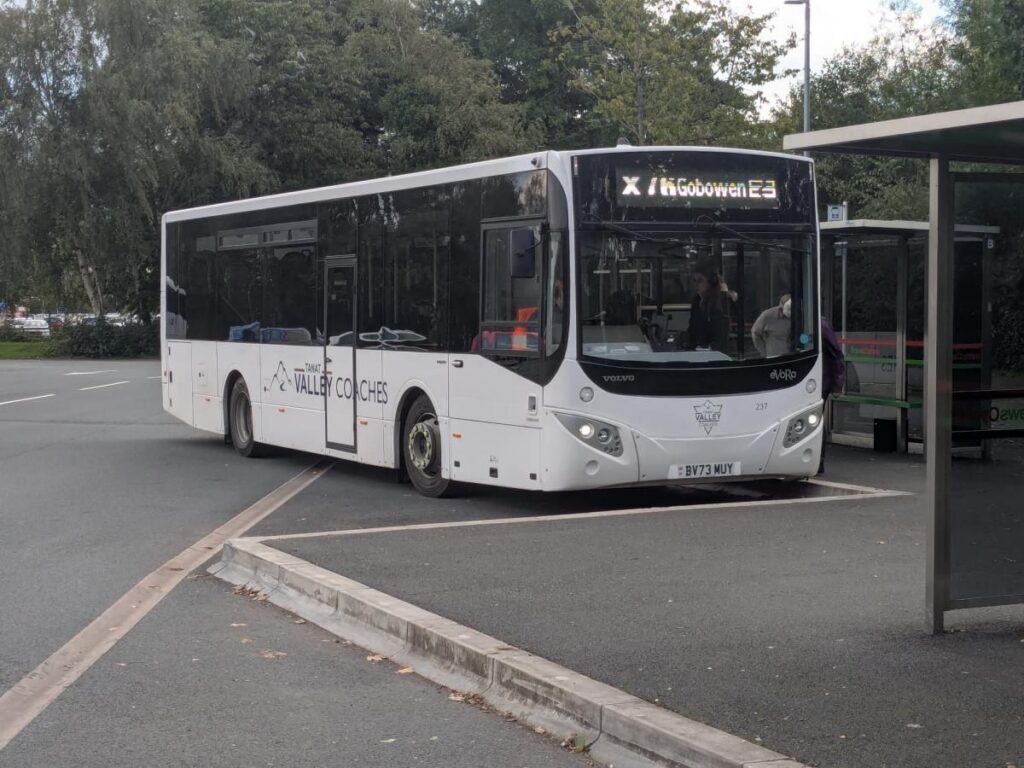
To mark UK Parliament Week – an annual event promoting what Parliament is, what it does, and how constituents can get involved in our democracy – I launched a Student Essay Competition, asking KS4 and KS5 pupils who go to school in the constituency to send in a 2000-word policy proposal on an issue affecting their local community.
A-level Jonathan Sydney Banks (Syd) from Ysgol Bro Caereinion, who also takes politics classes at Welshpool Sixth Form, has won this year’s competition with an excellent proposal on Demand-Responsive Transport.
I have invited him down to meet me in Parliament for a tour of the Palace of Westminster.
You can read his policy proposal below:
Montgomeryshire and Glyndŵr can be described as one of the most rural constituencies in both Wales and the rest of the United Kingdom, characterised by rolling hills filled with small villages, dispersed settlements, and a limited number of market towns serving a population of around 74,000, according to the ONS.
While rural areas often benefit from strong community ties, environmental advantages and our importance in the agricultural sector, poor transport connectivity presents significant social and economic challenges for many residents in rural areas, both across the constituency and the rest of the UK.
Long travel times to essential services such as healthcare, education, employment and retail mean that inadequate public transport can leave many individuals socially and economically isolated. Geographic inequality in transport provision creates a postcode-based disparity, whereby residents living closer to market towns benefit from greater transport access than those in more remote areas.
This issue is particularly profound in Montgomeryshire and Glyndŵr due to its proximity to the English border, with many residents relying on cross-border travel into Shropshire for healthcare, further education, retail, and further transport links to the rest of the UK.
However, this is not an abstract concern, but a considerable local and national problem. Across Wales, over 80% of the land is classified as rural, with around 1/3 of the population living in rural areas. Approximately 1/4 of this rural population experiences some level of poverty. Transport costs play a considerable role in this inequality.
Sustrans Cymru reports that close to half of Welsh households spend more than 10% of household income on transport alone, which is a widely accepted indication of transport poverty. Rural households are therefore disproportionately affected due to limited public transport alternatives.
Public transport provision in Wales has declined sharply over the past decade. For instance, since 2010, bus provision across Wales has fallen significantly, with many areas experiencing reductions of 50% in bus trips per hour. National survey data show that regular bus users are substantially lower in rural Wales than in urban Wales, which reinforces a structural imbalance between demand, provision, and accessibility.
Locally, the situation is particularly worse. Transport planning documents show that Mid Wales has the lowest access to bus and rail stops of any region in Wales, with only a small minority rather than living within a short walking distance of public transport routes. In Powys, which covers a significant portion of the constituency, public transport accounts for only 1.6% of journeys to work. This illustrates the extent to which rural residents are excluded from public transport networks and, thus, society at times.
Although approximately 9 in 10 rural residents have access to a car, this reflects forced car ownership rather than genuine choice. Rising public transport fares, which have increased far more frequently than fuel prices, further undermine the affordability and viability of public transport for many rural residents, especially low-income, students and pensioners. One example of this is that Powys has an ageing population with around 1/4 of residents aged over 65 alongside disabled residents and those unable to drive, all of whom are disproportionately excluded by the current weak provision of transport.
Taken together, this evidence demonstrates that Montgomeryshire and Glyndŵr does face a structural transport deficit. Declining services, poor geographic coverage, and high costs restrict access to these essential services whilst entrenching regional inequality between rural and urban parts of Wales.
For any Labour Government committed to social justice, equality of opportunity and devolved decision making, rural transport offers both a challenge and an opportunity. By building on existing blocks, government innovations and operating within the financial and political constraints in the modern world, I feel this proposal demonstrates how pragmatic state intervention can reduce transport poverty in rural areas such as our constituency, whilst also delivering value for money.
Rural transport provision faces structural challenges that distinguish it fundamentally from urban counterparts seen in Cardiff or London. Low population density, irregular demand, geographical constraints, and long travel distances typically make traditional fixed route bus services inefficient and costly for many areas. Additionally, coupled with low passenger numbers, this often leads to poor value for money and the eventual withdrawal of such services.
This pattern is quite evident in our constituency, with bus trips per hour having fallen by approximately 50% since 2010 in Powys alone, according to one study. As councils and bus operators respond to financial pressures, many villages experience infrequent services, limited operation hours or complete route withdrawals, particularly during evenings and weekends. This creates a cycle of decline in which reduced services lead to lower passenger numbers, justifying further cuts.
The social impact of this decline can be quite significant, as older people, young people, and disabled residents in low-income households are more likely to rely on public transport. When this connectivity is restricting, access to healthcare appointments, education, employment, retail, and social participation is affected, which in turn can affect the isolation and dependency that an individual may feel.
In such, this represents a clear case of market failure, as in rural areas the private market fails to provide adequate transport services because low demand density makes the provision unaffordable. Without enough state intervention, transport services are then withdrawn or reduced, reinforcing inequality and the rural/urban divide.
Therefore, transport policy is not merely a technical issue, but a political one, linked to social justice, freedom and the role of the state. Access to transport shapes individuals’ ability to participate fully in society and exercise meaningful choices. Additionally, inadequate rural transport undermines positive freedom by limiting real opportunities rather than formal rights given by a state.
From a social democratic perspective, state intervention is justified to correct market failure and ensure universal access to such essential services. I feel this aligns with Labour’s commitment to fairness, community cohesion and reducing regional inequalities. Therefore, improving rural transport is thus a necessary component of a just society.
The aim of this policy proposal is to reduce rural transport inequality in the constituency by expanding demand-responsive transport (DRT) to provide reliable, affordable access to transport services across our area by a pre-determined date which would be allow the proposal enough time to bolster support and commitment, without imposing unrealistic or rushed implementation.
Demand-responsive transport (DRT) allows for adjustments to certain routes and timetables based on pre bookings rather than a fixed schedule, making it particularly suitable for low-density rural areas such as vast parts of our constituency. Even better, Wales is already piloting this approach through the fflecsi service, operated by Transport for Wales in areas such as Denbighshire, Gwynedd, and the Llŷn Peninsula. This demonstrates that similar solutions are viable close to our area.
There is the even the opportunity to extend cross-border services through partnerships with English border towns such as Shrewsbury and Oswestry given our dependence on them for services ranging from education, healthcare, transport, and retail. Similarly, partnerships with Wrexham Council could certainly create more DRT routes.
Additionally, local authorities such as Powys County Council already have commissioned support for local bus services which work together with community ran Dial-A-Ride schemes found in various market towns in our constituency.
This shows that Powys already has the institutional responsibility to handle a change in our transport system. This however should not be an excuse to pull the plug on successful bus routes found primarily between the market towns themselves, and more like a partnership between the different modes that could be available.
Welsh Government’s early evaluations indicate that this system has increased access to public transport in areas previously without regular services. Typical users are disproportionately older people, younger people and those without access to a car, showing that DRT reached the group most at risk of transport exclusion in typical scenarios.
From an economic perspective, DRT offers improved value for money by avoiding the inefficiency of running near-empty buses, making services more financially suitable for both the local authority and operators.
Funding for this proposal could be achieved through a combination of reallocation within existing Welsh Government and local transport budgets, targeted rural mobility grants, and savings generated by replacing inefficient fixed route services in vast parts of our constituency.
While concerns based on predictability and digital exclusion are understandable, evidence from both the Welsh Government and Transport for Wales have shown that fflecsi pilot schemes have given DRT the best scenario as it has increased accessibility without reducing reliability, particularly for older residents, young people, and residents without access to cars, the target audience for DRT’s need.
The success of this proposal should be measured through clear indicators such as a 20% in rural passenger journeys by a predetermined date, improved geographical access to essential services, reduce reliance on taxis for basic travel (say within a 15-mile radius) and demonstrable improvements in cost-effectiveness compared with previously withdrawn or underused fixed routes.
Although bus services are devolved to Wales, it is equally important for the UK Government to play its crucial role through national funding framework, settlements which come yearly and ultimately shape the resources available to the Welsh Government for transport investment, including DRT.
Therefore, effective delivery and cooperation is required among all levels of government from local authorities such as Powys County Council’s implementation of services, the Welsh Government’s role in providing the strategic overhead, and the UK Government’s role in ensuring that fair and sustainable funding is available and justified.
Lastly, the UK Government does have responsibility to support cross-border coordination, particularly given Montgomeryshire and Glyndwr’s reliance on English towns close to the border such as Shrewsbury and Oswestry for healthcare, education and onward rail connections as mentioned above.
Ultimately, rural transport inequality in Montgomeryshire and Glyndŵr is a real and pressing policy issue with possible solutions available. By expanding Demand-Responsive Transport within Wales’s devolved governance framework allows for the possibility of other problems that we face in our constituency to be at least considered, and hopefully fixed.
This proposal offers a realistic and evidence-based solution aligned with Labour’s values. Improving transport is not simply moving people from one place to another, whether it be for rural or urban populations.
It is about ensuring that where someone lives does not determine their life chances and opportunities, through coordinating action between local authorities, the Senedd and the Department for Transport.
Montgomeryshire and Glyndŵr could be the model for adequate rural transport alongside the several sites already served by DRT across Wales and the rest of the UK.
Jonathan Sydney Banks
References / Evidence Base
- Rural Wales: Population, poverty, and geography
| Source | Link |
| Welsh Government’s statistics on Rural Wales:Evidence on rural population, land area and socio-economic context | Statistics and research | GOV.WALES |
| WCPP – Rural Poverty in WalesSupports: rural poverty context and differentiated rural causes | Rural Poverty in Wales | WCPP |
| Sustrans Cymru: Transport Poverty Briefing (“Making the Connection”) Supports: ~40-50% households spending>10% on transport, rural areas worst affected | People in Wales facing transport poverty reality, says Walk Wheel Cycle Trustreport – Walk Wheel Cycle Trust |
- Decline in public transport since 2010
| Source | Link |
| Senedd Research Bus services on life support: how did we get here?Supports: long-term decline in bus passenger journeys and service levels in Wales | Bus services on life support: how did we get here? |
| Sustrans report: bus vehicle number reduction (2010–current)Supports decline in buses and lack of local public transport links | North Wales Transport Commission Progress Statement 2023 • Bus Users |
| Nation. Cymru: Wales bus passengers down since before COVIDSupports: overall drop in bus passenger journeys | Wales has lost more than 20% of its bus passengers since before Covid while train reliability remains patchy |
- Rural vs urban transport access
| Source | Link |
| National Survey for Wales – Transport findings | Transport (National Survey for Wales): April 2022 to March 2023 [HTML] |GOV.WALES |
| Supports transport access differences, car access and bus usage trends | |
| Mid Wales Regional Transport Plan (Powys)Supports: low geographic access to bus/rail stops in Mid Wales | MWRTP_Appendix_1 Case for Change.pdf |
- Car access and demographics
| Source | Link |
| National Survey for Wales: Transport Supports: 88% of Welsh residents have access to a car; urban vs rural differences | Transport (National Survey for Wales): April 2022 to March 2023 [HTML] | GOV.WALES |
| ONS: Census and population profile for PowysSupports: ageing population evidence for Powys | How life has changed in Powys: Census 2021 |
- Cost pressures: fares vs fuel
| Source | Link |
| Sustrans “Making the Connection” reportSupports: transport costs rising faster than fuel, bus and rail fare increases | People in Wales facing transport povertyreality, says Walk Wheel Cycle Trust report – Walk Wheel Cycle Trust |
| ONS Transport CPI / price inflation data | Inflation and price indices – Office forNational Statistics |
- Market failure and rural transport inequality
| Source | Link |
| WCPP: What Works in Tackling Rural PovertySupports: rural inequalities including transport disadvantage | What Works in Tackling Rural Poverty | WCPP |
| Welsh Government: Rural Community Development / EvidenceShows that rural disadvantage in access occurs and requires tailored responses | Rural Community Development Fund: guidance | GOV.WALES |
- Demand Responsive Transport (DRT) and fflecsi
| Source | Link |
| Transport for Wales: fflecsi overviewSupports: fflecsi as a demand responsive transport pilot across Wales | fflecsi – Demand Responsive Transport | Transport for Wales |
| Transport Focus: Fflecsi evaluation report Supports: evaluation of user experience and service performance | fflecsi-–-the-experience-of-Demand-Responsive-Transport-in-Wales-Updated-report-–-findings-from-passenger-research-in-Newport.pdf |